Description
In this lesson, students will infer relationships in history from prior knowledge about the Plaza Mayor, King Philip III, and the Islamic presence in early Spain. Students will also interpret an excerpt of Cervantes’ "El coloquio de los perros" and how it serves as a commentary on Christian views of the Moriscos in the early 17th century.
Objectives
- Students will infer relationships in history from prior knowledge about the Plaza Mayor, King Philip III, and the Islamic presence in early Spain.
- Students will interpret an excerpt of Cervantes’ El coloquio de los perros and how it serves as a commentary on Christian views of the Moriscos in the early 17th century.
- Students will use context clues to determine whether to use the preterite or imperfect tense.
- Students will compare current Spanish words with their corresponding Arabic roots.
Essential questions
- Who was King Philip III? Who were the Moriscos?
- What were the causes and results of the Expulsion of the Moriscos from Spain in the 17th century?
- How does Cervantes’ El coloquio de los perros serve as a commentary on Christian views of the Moriscos in the early 17th century?
Key terms
- adoptar to adopt
- el antepasado ancestor
- el/la árabe Arab
- asimilar(se) to assimilate
- cristiano, -a Christian
- dejar huellas to leave marks, traces
- la descendencia descent, ancestry
- la época time, era
- expulsar to expel
- el grupo étnico ethnic group
- la herencia heritage
- el idioma language
- la influencia influence
- integrarse to integrate
- la mezcla mix
- el musulmán, la musulmana Muslim
- la raza race
- el resultado result, outcome
- la semejanza similarity
- la unidad unity
Academic summary
In 1492, the last Muslim state of Iberia fell to the Spanish Reconquista. Spain had finally regained control of the Iberian Peninsula, after over seven centuries of conflict. However, nearly 500,000 Muslims still considered the country home. Ferdinand and Isabella, the Spanish monarchs at the time, eventually set to work trying to convert the remaining Muslim population to Christianity. Rather than leave Spain or Portugal, many of these people unwillingly agreed to be baptized. The term morisco, meaning “Moorish”, became the term used to describe these newly-converted peoples.
Soon enough, morisco became more commonly used to address Christians who were suspected of practicing Islam in secret, as this often seemed to be the case. Muslims would accept bribes from Christians trying to convert them, be baptized, and then return to Islam. This upset Ferdinand and Isabella, and in 1499 conversion became much more violent. Muslims who refused to convert had their land taken from them, or were tortured and sent to prison. This incited a string of rebellions from the Muslim community against Christian rule. In 1502, Queen Isabella was fed up, and declared that she would no longer tolerate any Muslims in Spain. All Muslims would have to convert to Christianity, leave Spain, or die. Many chose to convert so that they could stay in Spain, but still continued to practice Islam in secret.
Throughout the years, the monarchs of Spain suspected that this was the case. Finally, in 1609 – over 100 years after Queen Isabella’s threat of exile – the then-current king of Spain, King Philip III, decreed the Expulsion of the Moriscos. The Decree of Expulsion contained these points1:
- All Moriscos in Spain had three days from the publication of the decree to gather their portable property and report to authorities. From there they would be provided with ships and sustenance for the voyage to North Africa. Anyone who did not comply would be killed.
- Any Morisco remaining in Spain after three days could legally be robbed and killed.
- After publication of this decree, Moriscos had to stay in whatever domicile they were in at that time until authorities could come and escort them to the port.
- Moriscos could be killed if they tried to hide or burn their own property; the King planned on giving all non-moveable property to his vassals.
- No Old Christian or soldier can mistreat Moriscos.
- No one can hide or conceal Moriscos under penalty of six years in the galley.
- Moriscos cannot be harassed on their way out of Spain, and ten Moriscos from the first ship would be allowed back to Spain to provide proof.
- Morisco boys and girls under four years of age can stay in Spain if they choose to.
- Boys and girls under age six can stay in Spain if their father is Old Christian and their mother is Morisco. If the father is Morisco, he was expelled while the Old Christian mother and children could stay.
- Moriscos can stay if they have lived among Christians and not attended the council of the aljama [community].
- Moriscos can stay if they received the Holy Sacrament with the permission of the prelates.
- If Moriscos want to go to other kingdoms besides North Africa, they can, but cannot pass through other Spanish kingdoms on the way.
Under these terms, the Spanish government forced all Moriscos to leave the country, one city at a time. By 1614, nearly 325,000 Moriscos had been expelled from Spain. The expulsion was complete.
In this lesson, students will infer relationships in history from prior knowledge about the Plaza Mayor, King Philip III, and the Islamic presence in early Spain. Students will also interpret an excerpt of Cervantes’ El coloquio de los perros and how it serves as a commentary on Christian views of the Moriscos in the early 17th century.
1 “Expulsion of the Moriscos”, Sarah Bachmann. http://sbachmann360.umwblogs.org/decree-of-expulsion/
Materials
- Plaza Mayor Picture
- El coloquio de los perros Worksheet
- Spanish-English Dictionary
- Práctica: Pretérito vs Imperfecto (Felipe III) Worksheet
- Raíces árabes en Español Worksheet
Procedure
I. Anticipatory Set (10 min)
- Show a picture of the Plaza Mayor. Can anyone identify it? What do we already know about the Plaza? Brainstorm as a class.
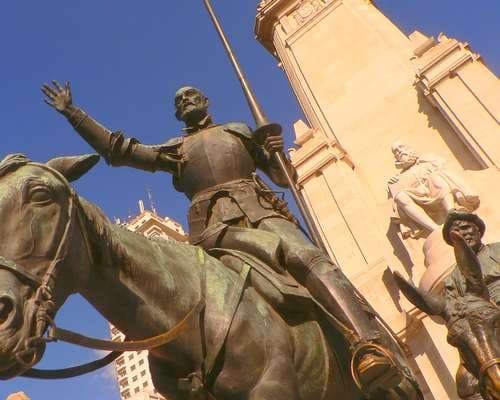
- Intro to Plaza Mayor: A famous plaza in Madrid, Spain, the Plaza Mayor was built from 1617-1619. It is rectangular in shape, measures 423 ft x 308 ft, has nine entranceways, and is surrounded by three-story buildings with a total of 237 balconies, all facing the Plaza. At the center of the Plaza is a bronze statue of King Philip III on horseback.
- Intro to King Philip III: Reigned from 1598 to 1621. His father, King Philip II, thought he was unfit to rule the kingdom. He is now known as an “undistinguished and insignificant man” (C.V. Wedgwood) and a “miserable monarch” (R. Stradling). Why do you think there is a statue of him in one of the most popular sites in Madrid if he had such a bad reputation? (Answer: The Plaza was constructed during his reign.)
- Why does King Philip III have a bad reputation? Many reasons, including economic decline and the entry into the Thirty Years’ War- but today, we will be focusing on the Expulsion of the Moriscos from Spain.
II. Body of Lesson (45 min)
- Expulsion is the act of driving someone or something out. What is a Morisco, and why do you think King Philip III wanted to force them out of Spain? Think-Pair-Share.
- Definition of Morisco: In 1502, King Ferdinand and Queen Isabella declared Islam illegal throughout Spain. Many Muslims decided to convert to Christianity rather than leave their homes. The Moriscos are the descendants of these people. Although they were Christian on the surface, they still had a unique culture with many Islamic practices.
- Would this be something acceptable to do nowadays? Can you imagine such a thing happening today, in America? Read El coloquio de los perros worksheet in groups of two or three, with a Spanish-English dictionary. Written by Cervantes and published in 1613, this excerpt provides a commentary on the Christian view of the Moriscos in Spain at the time of the Expulsion. Review content and reactions as a class.
- Complete Practice: Preterite vs. Imperfect worksheet with a partner. Correct as a class. What else did we learn about the Expulsion of the Moriscos from this worksheet? What was your reaction?
III. Closure (5 min)
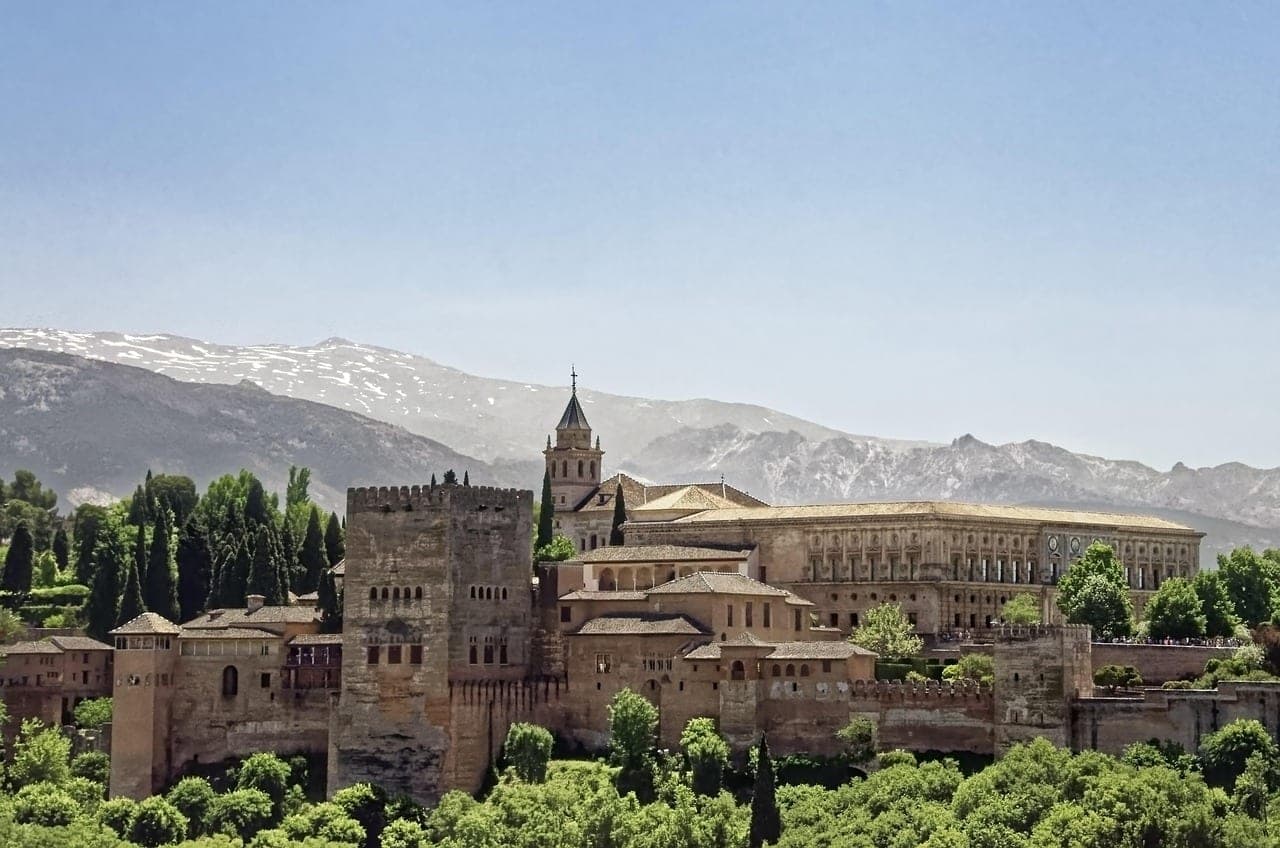
- In the end, King Philip III succeeded in ridding Spain of the Moriscos. However, there is still a heavy Islamic influence in all parts of Spain- from architecture, to math and science, to language.
- Homework: Arabic Roots in Spanish Language
Extension
On tour: Plaza Mayor, Madrid
Over time, the Plaza Mayor has been the backdrop for a variety of events- from markets, bullfights and soccer games to public executions. Nowadays, it is a popular place to socialize, eat and live life like a real madrileño. Browse the cafes, shops and restaurants in the Plaza Mayor. Can you find five examples of Islamic influence?
Tour sites
Places our tours visit that bring this lesson to life.
- Statue of King Philip III, Plaza Mayor, Madrid
Further reading
- passports.com/group_leaders/on_the_road/spain/historical_sketch
“Spain: Historical Sketch”, an On the Road essay by Passports Educational Travel. Written from the viewpoint of a Passports courier. A brief history of Spain, from its origin until the Spanish Civil War. - en.wikipedia.org/wiki/Timeline_of_the_Muslim_presence_in_the_Iberian_Peninsula
“Timeline of the Muslim presence in the Iberian Peninsula”, Wikipedia. A timeline of events in the Muslim Empire in Iberia, ranging from the Umayyad conquest in the early 8th century, to the ending of the Expulsion of the Moriscos in 1614. - sbachmann360.umwblogs.org/about/
“Expulsion of the Moriscos” (2010), a blog by Sarah Bachmann. Highlights who the Moriscos were, the Expulsion of the Moriscos, their expulsion in literature, and Moorish art. - lostislamichistory.com/
“Spain’s Forgotten Muslims – The Expulsion of the Moriscos” (9 Nov 2010). From “Lost Islamic History”, a website by Firas Alkhateeb, a history teacher at Universal School in Bridgeview, IL. LIH is dedicated to educating all people, regardless of religious affiliation, about the story of the Muslims of the past. - www.ciudadseva.com/textos/cuentos/esp/cervan/el_coloquio_de_los_perros.htm
“El coloquio de los perros”, Miguel de Cervantes Saavedra. Complete text of the short story. From Cuidad Seva, an electronic database of Spanish and Latin American texts. Luis López, San Juan, Puerto Rico, 1995.
Credit
© Copyright 2013 Passports, Inc., All rights reserved.