
Welcome.
You’re here.
The hour-by-hour walkthrough of your first day on tour — from the moment you exit customs to the moment your head hits a hotel pillow ten time zones from home.
- Hour by hour: customs through your welcome dinner
- How to spot your Tour Director at the airport
- What to do (and not do) when you can't check into your hotel yet
- The Tour Director jet-lag protocol — six rules
- Combined groups, busy season, and other arrival-day quirks
Day one isn’t a sightseeing day. It’s a landing day. Treat it that way and you’ll feel like a human by day two.
The travelers who try to push through and see eight things on day one are the ones who melt down on day three. The travelers who hydrate, walk, eat the meals served, and sleep at the local hour are the ones who feel like locals by day four. Pace yourself. The whole rest of the trip is waiting.
Ten moments, in order.
From wheels down to lights out.
Times below are typical for a morning arrival in Europe — adjust earlier or later based on your itinerary. Your group leader and Tour Director will tweak the plan if your flight lands at an odd hour.
- Hour 0Step 01
Wheels down.
Your plane lands. You probably slept badly. Splash water on your face, brush your teeth, change your shirt. The first impression you make on a continent is one you make on yourself.
- + 30 minStep 02
Customs and immigration.
Have your passport, your customs form (if there is one), and your itinerary ready. Smile, answer the question they ask, move along. Most of the time you're stamped through in under five minutes.
- + 60 minStep 03
Baggage claim.
Find your group. If you traveled carry-on, walk past the carousel feeling smug. If you checked, claim your bag. Look for your group leader; they'll be the one with the clipboard.
- + 75 minStep 04
You meet your Tour Director.
Just past customs. They have a Passports sign, a coach lined up outside, and a plan. You'll know your group is complete when they count to 40 and don't say any of the names twice.
- + 2 hoursStep 05
Coach to the city.
Your TD will brief on the way. The hotel address, the day's plan, the meeting point for tomorrow. They'll tell jokes; you'll laugh; you'll probably also fall asleep on the bus. Both are fine.
- + 3 hoursStep 06
Hotel — luggage hold.
Most rooms aren't ready until 3 PM. The hotel will store your luggage. Splash water, change socks, grab a coffee, then meet the group in the lobby in 20 minutes. Don't lie down. Trust us.
- + 4 hoursStep 07
First walk.
Light orientation. Cafe. Maybe a market. Your TD will point out the closest ATM, the nearest pharmacy, the metro stop you'll use. Soaking in the morning light is doing more for your jet lag than caffeine ever could.
- + 6 hoursStep 08
Lunch, then the afternoon's first big view.
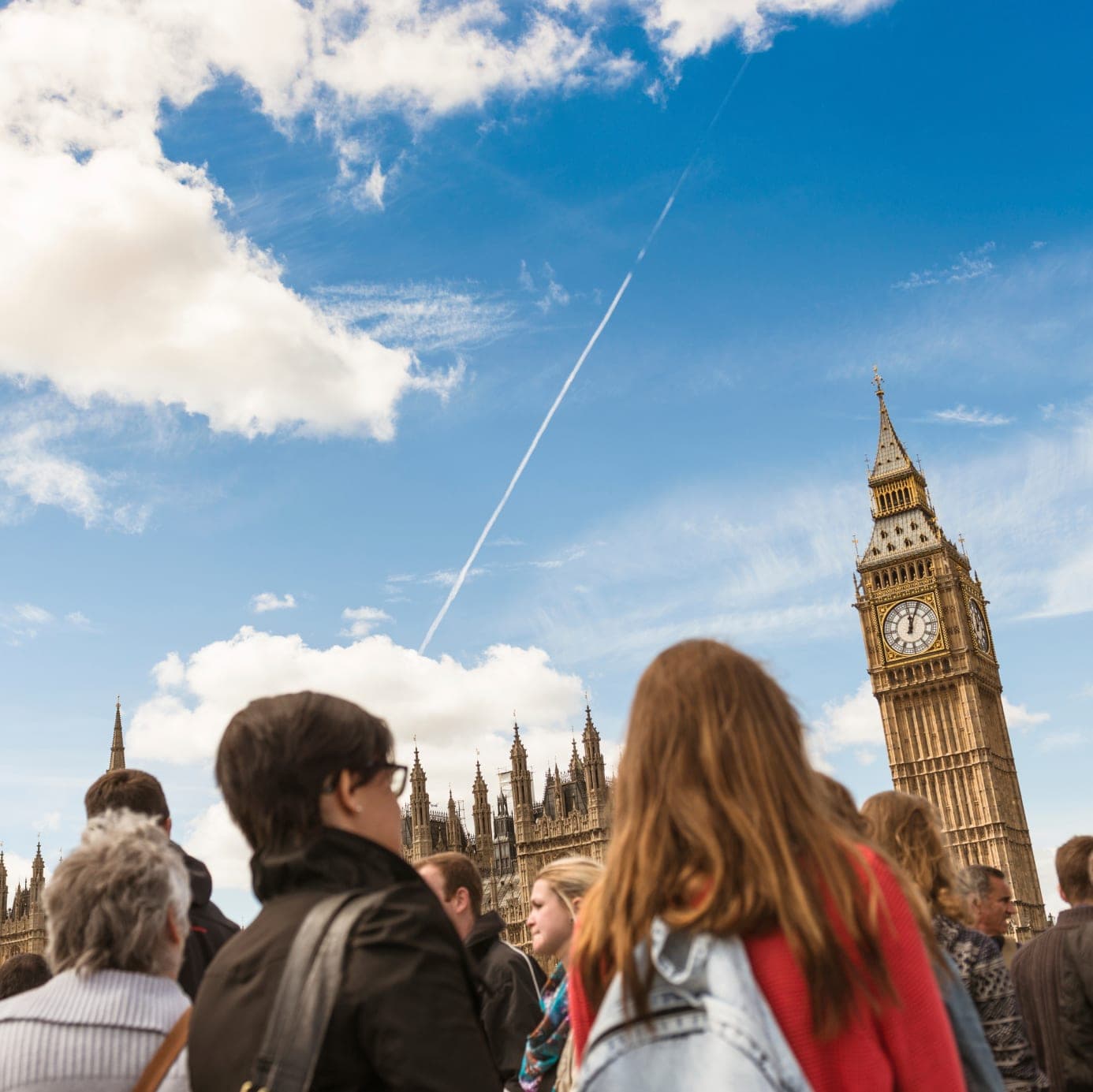
A standing lunch — sandwiches at a café, a bakery counter, a food hall your TD knows. Then the afternoon's signature: the climb up to Sacré-Cœur from Anvers in Paris, the basilica looming over the city as you crest Montmartre. Big Ben, Westminster, the South Bank in London. The streets fanning out from Sol in Madrid. Sometimes it's a stop at a mall — foreign malls are weirdly thrilling at sixteen. Whatever it is, it's the first time the city feels like the city you came to see.
- + 9 hoursStep 09
Welcome dinner — early.
Six PM, at a restaurant our operations team in Worcester booked weeks ago. Your TD walks you over. Three courses, often family-style — and we ask the kitchen to push it through quickly because by now the group is running on fumes, and the goal is back to the hotel and into bed as fast as possible. You will eat something you've never seen before. You will love it.
- + 11 hoursStep 10
Sleep — at the local time.
Walk back to the hotel. Shower. Lights out at the local hour you'd normally go to bed. Tomorrow morning will be rough. The morning after tomorrow will feel completely normal. That's how this works.
Beating jet lag, in six rules.
Crossing five time zones is rough on the body. Crossing eight is rough on the soul. The protocol below is what every Passports Tour Director has been teaching their groups for thirty years. Follow it and you’ll be on local time inside 48 hours.
Reset your watch the moment you take off.
Don't keep doing time-zone math. Switch to local time, eat when they serve dinner-now-it's-breakfast, sleep when the cabin goes dark.
Sunshine + walking + water.
Outdoor light is the strongest tool you have for resetting your circadian rhythm. A 30-minute walk in fresh air is worth more than a 3-hour nap.
Don't take a real nap.
If you absolutely must, set a 30-minute alarm and don't lie down on a real bed. A bench, the bus, a chair in the lobby. Anywhere you'll naturally wake up.
Eat light, often, hydrate constantly.
Heavy meals make jet lag worse; small frequent meals keep your blood sugar steady. Trade caffeine for water after lunch. Your body is already overloaded.
Local bedtime, no exceptions.
Going to bed at 7 PM means waking up at 3 AM. Push through to a normal local bedtime — 9 or 10 PM. By night two, you'll be on local time.
Skip the sleeping pills.
Melatonin is fine in moderation; prescription sleep aids stack on jet-lag fog. Natural adjustment is faster, and you won't feel like you've been hit by a bus on day three.
A few things that may surprise you.
Arrival day is mostly the script above — but a handful of edge cases come up regularly enough that we want you to know about them in advance.
Combined groups.
Two or three Passports groups arriving at similar times may share a coach to the same hotel. An assistant TD might escort you while your permanent TD is collecting a different flight. This is normal — your TD will introduce themselves at the hotel.
Busy season dynamics.
In peak summer, lines for customs, baggage, and even the hotel front desk run long. We pad the schedule for it. Bring a book, bring patience. Your TD has done this fifty times.
Restroom etiquette.
W.C. = water closet = restroom. Many overseas restrooms are co-ed. A few have attendants — small change (50¢ or a £1) is appreciated. Don’t be the traveler who refuses to use them.
Hands on the table.
In much of continental Europe — France especially — the polite thing at a meal is to keep both hands visible above the table, wrists resting lightly on the edge. The American instinct (one hand in your lap) reads as oddly secretive. Historical hangover from when an unseen hand might be hiding a weapon; today it’s just manners. Your TD will mention it at the welcome dinner.
Culture shock is real.
The first few hours abroad can feel disorienting. The bread is denser, the cars are smaller, the streetlights are different colors. Embrace it with curiosity rather than resistance. The unfamiliarity is the entire point.
Now what does the rest of the trip look like?
Your day-by-day on tour: meals, free time, public transit, weather, the people you’ll see every day, and the rhythm that ties it all together.