Description
Through the investigation of selected primary and secondary sources, including a full text reading of Plato’s dialogue Euthyphro, students in this lesson will identify, understand and be able to explain the basics of the Socratic argument behind defining piety and justice, how Socrates uses logical reasoning to question Euthyphro’s assertions, and what modern readers can take from the story.
Objectives
- 1. Students will identify, understand and be able to explain the basics of the Socratic argument behind defining piety and justice in Plato’s Euthyphro.
- 2. Students will identify, understand and be able to explain how Socrates used logical reasoning to question Euthyphro’s assertions about piety and justice.
- 3. Students will identify, understand and be able to explain how Socrates’ ideas influenced, and continue to influence, philosophical thought in the western world and what modern readers might be able to take from Plato’s Euthyphro.
Essential questions
- Who was Plato? What was his relationship to Socrates?
- How did Plato use his dialogues to teach logic and wisdom?
- What was Plato’s basic story / plot in his dialogue The Euthyphro? Who are the characters? What is the message Plato’s trying to teach through the dialogue?
- According to Plato and Socrates, is it possible to define Piety and Justice?
- Why is Plato’s Euthyphro still relevant 2400 years after it was written?
Key terms
- Ancient Greece
- Justice
- Philosophy
- Piety
- Plato
- Platonic Dialogues
- Socrates
- Socratic Method
- Wisdom vs. Knowledge
Academic summary
Socrates as quoted in Lives and Opinions of Eminent Philosophers, 3rd century CE
There is only one good…knowledge
and only one evil…ignoranceSocrates as quoted in Plato’s dialogue Theaetetus, 4th century BCE
I myself know nothing, except just a little, enough to extract an argument from another man who is wise and to receive it fairly.
Socrates as quoted in Plato’s Apology, 4th century BCE
The unexamined life is not worth living for a human being.
Excerpts from Plato’s dialogue Euthyphro, 4th century BCE
Euth. Yes, I should say that what all the gods love is pious and holy, and the opposite which they all hate, impious.
Soc. Ought we to enquire into the truth of this, Euthyphro, or simply to accept the mere statement on our own authority and that of others? What do you say?
Euth. We should enquire; and I believe that the statement will stand the test of enquiry.
Soc. We shall know better, my good friend, in a little while. The point which I should first wish to understand is whether the pious or holy is beloved by the gods because it is holy, or holy because it is beloved of the gods.
Euth. I do not understand your meaning, Socrates.
Soc. I will endeavor to explain: we, speak of carrying and we speak of being carried, of leading and being led, seeing and being seen. You know that in all such cases there is a difference, and you know also in what the difference lies?
Euth. I think that I understand.
Soc. And is not that which is beloved distinct from that which loves?
Euth. Certainly.
Soc. Well; and now tell me, is that which is carried in this state of carrying because it is carried, or for some other reason?
Euth. No; that is the reason.
Soc. And the same is true of what is led and of what is seen?
Euth. True.
Soc. And a thing is not seen because it is visible, but conversely, visible because it is seen; nor is a thing led because it is in the state of being led, or carried because it is in the state of being carried, but the converse of this. And now I think, Euthyphro that my meaning will be intelligible; and my meaning is, that any state of action or passion implies previous action or passion. It does not become because it is becoming, but it is in a state of becoming because it becomes; neither does it suffer because it is in a state of suffering, but it is in a state of suffering because it suffers. Do you not agree?
Euth. Yes.
Soc. Is not that which is loved in some state either of becoming or suffering?
Euth. Yes.
Soc. And the same holds as in the previous instances; the state of being loved follows the act of being loved, and not the act the state.Euth. Certainly.
Soc. And what do you say of piety, Euthyphro: is not piety, according to your definition, loved by all the gods?
Euth. Yes.
Soc. Because it is pious or holy, or for some other reason?
Euth. No, that is the reason.
Soc. It is loved because it is holy, not holy because it is loved?
Euth. Yes.
Soc. And that which is dear to the gods is loved by them, and is in a state to be loved of them because it is loved of them?
Euth. Certainly.
Soc. Then that which is dear to the gods, Euthyphro, is not holy, nor is that which is holy loved of God, as you affirm; but they are two different things.
Euth. How do you mean, Socrates?
Soc. I mean to say that the holy has been acknowledge by us to be loved of God because it is holy, not to be holy because it is loved.
Euth. Yes.
Soc. But that which is dear to the gods is dear to them because it is loved by them, not loved by them because it is dear to them.
Euth. True.
Soc. But, friend Euthyphro, if that which is holy is the same with that which is dear to God, and is loved because it is holy, then that which is dear to God would have been loved as being dear to God; but if that which dear to God is dear to him because loved by him, then that which is holy would have been holy because loved by him. But now you see that the reverse is the case, and that they are quite different from one another. For one (theophiles) is of a kind to be loved cause it is loved, and the other (osion) is loved because it is of a kind to be loved. Thus you appear to me, Euthyphro, when I ask you what is the essence of holiness, to offer an attribute only, and not the essence-the attribute of being loved by all the gods. But you still refuse to explain to me the nature of holiness. And therefore, if you please, I will ask you not to hide your treasure, but to tell me once more what holiness or piety really is, whether dear to the gods or not (for that is a matter about which we will not quarrel) and what is impiety?
It is said that his appearance disgusted many who saw him. It is said he had a big nose and large bulging eyes. By all accounts he was poor, dirty and unkempt, with long hair and a ragged beard. He seldom bathed, and it is said that every day he wore a dirty thin robe and no shoes. He wrote nothing, and yet his words have come down to us through the ages of history. It is possible that he may have been illiterate, yet he is considered by many in the western world to have been one of, if not the, greatest teacher of all time. In the end, he was arrested as an enemy of the state under the charge of corrupting others and blasphemy against the state religion. He was brought to trial and convicted by the citizens of the city for what today we would call treason and heresy. He was sentenced to death and although he had an opportunity to escape, he instead went willingly to his fate, drinking poison and dying in excruciating pain. In a parallel eerily similar to the story of a Roman citizen from Nazareth 400 years later, written accounts of his death describe the event as a sacrifice worthy of the ages, where he freely offered his life as an example to others. The legacy of his teachings have inspired countless generations of people for centuries and continue to do so today.
His name was Socrates.
What we know of Socrates comes mostly from Plato, a student of Socrates, although not in the modern sense of the word. Along the way, the master (as Plato called Socrates) acquired a following of men hungry for that knowledge. After Socrates was convicted and executed by the Athenian court in 399 BCE, Plato went on to write and publish stories about his mentor, and it is through those writings (probably biased through Plato’s eyes) that those of us in the modern world have come to know the wisdom and philosophy of Socrates. It has been said that philosophical thought since 399 BC has been in response to or as a result of Socratic virtues and ideas.
One of the most famous of Plato’s dialogues is called the Euthyphro, written shortly after the execution of his master. In the story, Socrates and Euthyphro meet in the courtyard of the judicial hall. Euthyphro, a young man, is on his way to court to prosecute his father for committing murder. Socrates is there because he has been arrested for being impious. Socrates begins by asking Euthyphro to define piety and virtue so he can learn what he did wrong and can thus be saved from punishment. Euthyphro comes up with a number of different definitions, each of which is refuted by Plato’s master as being examples of, but not the essence of, piety. Socrates then asks Euthyphro a question that has become one of the tenets of philosophical discussion over the last 2400 years, a question known as the “Euthyphro Dilemma.”
(Paraphrasing)
Is something pious (holy) because the gods will it to be so, or do the gods simply recognize something as pious because it already is?
The question seems simple enough, even to Euthyphro, but struggles to answer it. The problem is that if one says something is holy because the gods (or God in today’s monotheistic religions) will it to be so, then anything that the gods will to be must then be holy. Consequently, the gods themselves are arbitrary and thus piety is arbitrary. Accordingly, under this definition, the gods then could reverse their decisions and declare something pious that previously was impious. In the modern age, this idea is called the “Divine Command Theory”. Modern Judeo-based religions common in western society, including Christianity and Islam, believe that God’s nature is all good, so divine command isn’t an issue.
As Socrates points out in this dialogue, however, if something pious on its own, and thus the gods (or God) recognize it to be so, then the definition of piety would then be separate from religion. Piety would no longer be arbitrary, since its essence would be goodness, regardless of whether a divine entity wills it.
In the end, Euthyphro is so frustrated by Socrates and his questioning that he abandons reason and storms off. In the dialogue, Socrates never discovers the definition of piety, but he does gain more evidence on his search for wisdom. Perhaps by reading Plato’s Euthyphro, students can understand why an irritated Athenian citizenry put Socrates on trial. In Plato’s Apology, the story of the trial, Socrates claims to have never found wisdom, but rather to have found many people in Athens like Euthyphro who thought they were wise and in the end were really fools. Articulating that opinion did little to endear Socrates to the jury. He was summarily convicted and executed for impiety towards the gods and teaching others to follow him.
Through the investigation of selected primary and secondary sources, including a full text reading of Plato’s dialogue Euthyphro, students in this lesson will identify, understand and be able to explain the basics of the Socratic argument behind defining piety and justice, how Socrates uses logical reasoning to question Euthyphro’s assertions, and what modern readers can take from the story.
Procedure
I. Anticipatory Set
- Writing / Question: Is it possible to define moral and ethical concepts such as piety and justice? (5 min)
- Handouts – Copies of documents and readings from the websites listed. (5 min)
II. Body of Lesson
- Lecture / PPT – Plato’s Euthyphro (20 min)
- Video – Reenactment of Euthyphro (10 min)
- Independent Activity – Students read the sources on Plato’s Euthyphro, taking notes as appropriate. (20 min)
- Suggestion: Have the students read Euthyphro full text for homework before class.
- Suggestion: See links below for a worksheet with study questions on the Euthyphro.
- Group Activity – Socratic Seminar: Discussion on Plato’s Euthyphro. (15 min)
III. Closure
- Assessment / DBQ – Essay: Explain in detail how Plato’s Euthyphro articulates the basics of the Socratic argument behind defining piety and justice, how Socrates uses logical reasoning to question Euthyphro’s assertions, and what modern readers can take from the story.
- Alternative Assessment / Homework – Essay: Can piety and justice be defined? What do you think of Socrates argument and the Euthyphro dilemma?
Extension
On tour: Ancient Agora, Athens
While on tour, students in Athens can visit the Ancient Agora in the city center. The Agora was the public center of Ancient Athens, and was the center of government, commerce and daily life. Like the Ancient Roman Forum, the Agora was an open air space where Athenians would come to discuss everything from political issues to business transactions. Socrates would have been a daily fixture in the Agora during his lifetime. It is also where he was probably tried and convicted in 399 BCE. Excavations in the Agora, under the direction of the American School of Classical Studies at Athens, have been ongoing at the site since 1931. Just outside the southwest boundary of the Agora, archaeologists discovered a series of ancient jail cells, and tradition now holds that one of them was where Socrates died (although it is impossible to know for sure).
Tour sites
Places our tours visit that bring this lesson to life.
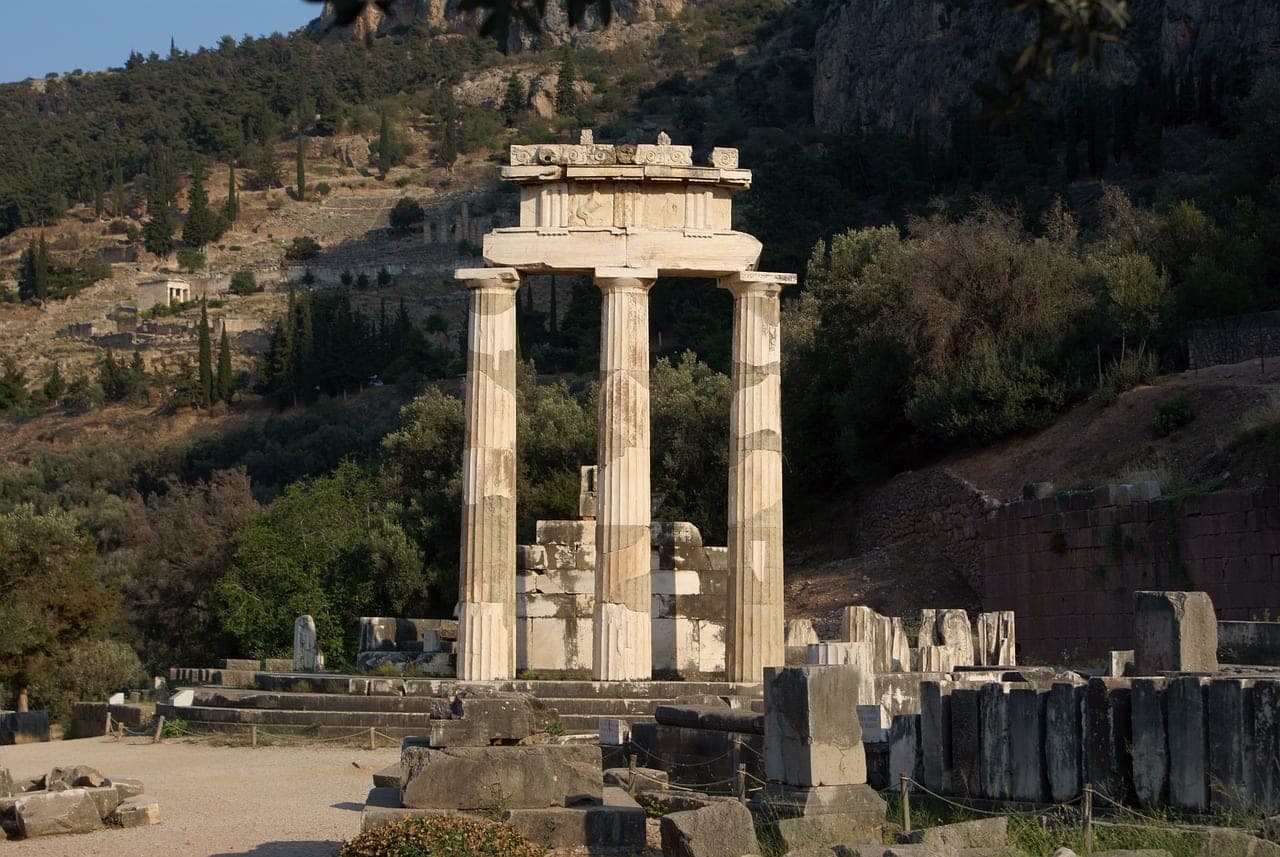
- Temple of Apollo, Delphi
- Athens Academy
- Athens Agora
- Socrates Prison, Athens
Further reading
Lesson Plan Websites
- www.indiana.edu/~p374/Euthyphro.pdf
The Euthyphro by Plato (primary source) – full text version from the University of Indiana - www.uri.edu/students/szunjic/philos/euth.htm
Plato’s Euthyphro (website) -- Contains primary and secondary sources on Plato’s work from the philosophy department at the University of Rhode Island - www.unc.edu/~megw/Euthyprho.html
Plato’s Euthyphro (lecture outline notes) – from Meg Wallace, graduate student in philosophy at the University of North Carolina - www.siue.edu/~wlarkin/teaching/PHIL111/euthyphro.html
Plato’s Euthyphro: Study Outline (study notes) – from William Larkin, Assistant Professor of Philosophy at Southern Illinois University Edwardsville (IL) - http://faculty.washington.edu/smcohen/Euthyphro.pdf
Socrates on the Definition of Piety: Euthyphro 10A – 11B (published academic paper) – from S. Marc Cohen, Professor Emeritus of Philosophy at the University of Washington - scottfenwickteachingeconomics.wikispaces.com/file/view/socrates+powerpoint.pptx
Socrates and the Socratic Method (PowerPoint). Basic outline of the man and his philosophy. - http://hume.ucdavis.edu/mattey/phi001/Euthyphro.ppt
Socrates and Euthyphro (PowerPoint) – from GJ Mattey, Department of Philosophy at UC Davis - www.teachingchannel.org/videos/choosing-primary-source-documents?fd=1
Reading Like a Historian: Primary Source Documents (video). Great 2-minute video on how to incorporate primary sources into the Common Core and history classes. From Shilpa Duvoor of Summit Preparatory Charter High School in Redwood City, CA. Highly recommended for teachers. - www.youtube.com/watch?v=hNs5TRJCago
Intro to Philosophy: Plato’s Euthyphro (video) – lecture by Gregory Sadler, Instructor of Philosophy at Marist College (NY). This 1 hour long video is highly recommended for out of class showings to AP and Advanced students studying the Euthyphro. - www.youtube.com/watch?v=9SNCDbrUzVA
Reenactment of Plato’s dialogues Part 1: Euthyphro (video) – Reenactment with modern language of the main portions of the Euthyphro produced by philosophy students at Virginia Tech University. This 8 minute video is appropriate for all students and classes. - www.youtube.com/watch?v=IqUCS0-EssI
Greeks: Crucible of Civilization Part III (video). This video, part of the PBS documentary on the Ancient Greeks, contains the story of Socrates (starting at the 10 minute mark). This video is about 55 minutes long, and so is probably too long for most in-class showings, but is highly recommended for students. - www.learner.org/resources/series58.html?pop=yes&pid=824#
The Western Tradition #6: Greek Thought (video). This 25-minute video, although perhaps too long for many in-class showings, is well worth watching. It is part of a much larger (52-part) series produced by WGBH TV in Boston in 1989 and features Dr. Eugen Weber, former history professor at UCLA and one of the foremost experts in Western History before his death in 2007. The series, called “The Western Tradition” consists of 52 lectures of 30 minutes each, and covers subjects from the Dawn of History to the Twentieth Century. Highly recommended for students and teachers.
Background Information
- www.en.wikipedia.org/wiki/Socrates
Socrates – Wikipedia article - www.en.wikipedia.org/wiki/Socratic_method
Socratic Method – Wikipedia article - www.en.wikipedia.org/wiki/Plato
Plato – Wikipedia article - www.en.wikipedia.org/wiki/Euthyphro
Euthyphro – Wikipedia article - www.en.wikipedia.org/wiki/Euthyphro_dilemma
Euthyphro dilemma – Wikipedia article - www.passports.com/group_leaders/on_the_road/greece/country_profile
On the Road: Greece – from Passports Educational Travel
Other Relevant Passports Lesson Plans
- www.passports.com/lesson_plans/greece/ancient-greece-homer-iliad
Ancient Greece – Homer’s Iliad - www.passports.com/lesson_plans/greece/ancient-greece-homer-odyssey
Ancient Greece – Homer’s Odyssey - www.passports.com/lesson_plans/greece/ancient-greece-minoan-civilization
Ancient Greece – Minoan Civilization on Crete - www.passports.com/lesson_plans/greece/classical-greece-alexander-the-great
Classical Greece (4th/5th Centuries BCE) – Alexander the Great - www.passports.com/lesson_plans/greece/classical-greece-sparta
Classical Greece (4th/5th Centuries BCE) – Sparta - www.passports.com/lesson_plans/greece/classical-greece-athens-democracy
Classical Greece (4th/5th Centuries BCE) – Athens - www.passports.com/lesson_plans/greece/classical-greece-battle-of-marathon
Classical Greece (4th/5th Centuries BCE) – Battle of Marathon 490 BCE - www.passports.com/lesson_plans/greece/classical-greece-battle-of-thermopylae
Classical Greece (4th/5th Centuries BCE) – Battle of Thermopylae: Leonidas and the 300 - www.passports.com/lesson_plans/greece/plato-allegory-of-the-cave
Classical Greece (4th/5th Centuries BCE) – Plato: Allegory of the Cave - www.passports.com/lesson_plans/greece/classical-greece-plato-euthyphro
Classical Greece (4th/5th Centuries BCE) – Plato: Euthyphro - www.passports.com/lesson_plans/greece/plato-republic-philosopher-kings
Classical Greece (4th/5th Centuries BCE) – Plato: Philosopher Kings and the Republic - www.passports.com/lesson_plans/greece/clasical-greece-socrates
Classical Greece (4th/5th Centuries BCE) – Socrates: Father of Western Philosophy
Credit
© Copyright 2014 Passports, Inc., All rights reserved.