- RegionSicily, Italy
- LanguageItalian (Sicilian widely spoken)
- CurrencyEuro (EUR)
- Best seasonApr - May, Sep - Oct
- TimezoneCentral European Time (UTC+1)
A quick introduction
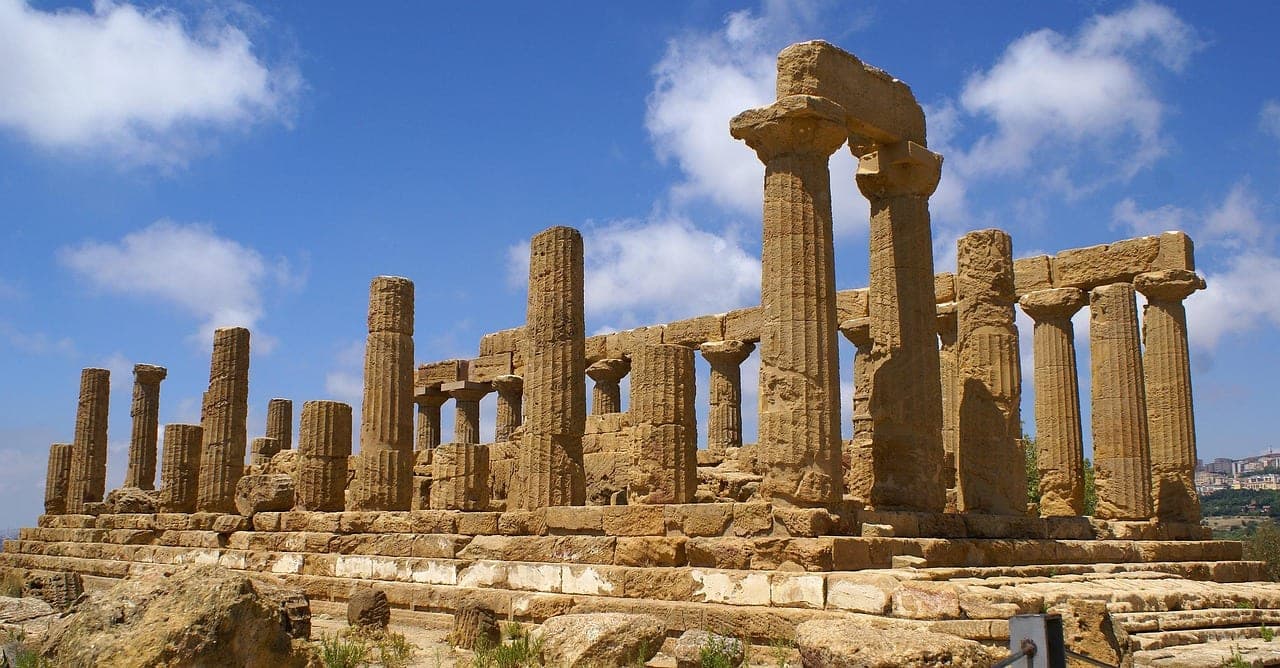
Agrigento sits on a ridge on the southern coast of Sicily, looking down over a 1,300-hectare archaeological park that holds the best-preserved cluster of Greek temples outside Greece itself. Founded around 580 BCE as the Greek colony of Akragas and later rechristened Roman Agrigentum, the ancient city once held somewhere between 200,000 and 300,000 people — the Greek poet Pindar called it "the most beautiful city of mortals." The modern town (~55,000 people, perched around 230 m above the sea) stacks Norman and Baroque churches along a ridge directly above the ruins.
For a student group, Agrigento is the ancient-Greece classroom stop in Sicily. On a Passports teacher-led trip, a morning in the Valley of the Temples puts AP Latin, Classical Civ, AP European History, and World History students inside the same landscape they've been reading about all year — and pairs naturally with Palermo, Syracuse, and Taormina to build a weeklong Sicily itinerary, or slots in as a single-day highlight from a wider Italy educational tour.
Top things to see and do


When to go
- Mar - May — spring, almond blossom
The sweet spot. Daytime highs climb from 16°C in March to 24°C in May, wildflowers carpet the temple park, and the Sagra del Mandorlo in Fiore (Almond Blossom Festival) draws folkloric groups from around the Mediterranean in early February to early March. For a teacher-led trip with a spring-break window, this is the move.
- Jun - Aug — hot, exposed, still workable
Sicilian summer is the real thing: daytime highs 32-38°C, the sirocco wind pushing hot air up from North Africa, and essentially zero shade across the ridge of temples. The park opens at 8:30 and runs extended evening hours (until 10 or 11 PM) in July and August for a reason — a summer student group should be in the valley at opening or after dinner, not at 2 PM.
- Sep - Oct — shoulder-season gold
Our favorite window after spring. Temperatures settle at 22-28°C, the sea is still warm enough for a Scala dei Turchi stop, the low-angle October light turns the Concordia travertine the color of honey, and the coach-tour volume drops sharply after the second week of September. A September or October high school group trip to Sicily is hard to beat.
- Nov - Feb — quiet, mild, short days
Mild Mediterranean winter (10-16°C), occasional rain, sunset around 5 PM in December, and almost no one in the park. The almond trees bloom in late January / early February — a quiet interim-term or MLK-week trip lands you in an empty Concordia at golden hour with blossoming trees in the frame. Some coastal restaurants close in January.
Food and culture

Arancini
Fried saffron-rice balls stuffed with ragù, ham and mozzarella, or spinach. Palermo-round and Catania-conical are different schools; Agrigento bakeries carry both. Standard student group street lunch.

Pasta alla Norma
Catania's signature pasta — tomato, fried eggplant, basil, and grated salted ricotta. Named for Bellini's opera Norma. Every trattoria in Sicily runs a version; the ricotta salata is the tell.

Cannoli
Fried pastry tubes filled with sweetened sheep's-milk ricotta to order — a pre-filled cannolo is a soggy cannolo. Candied orange peel or pistachio on the ends.

Granita con brioche
The Sicilian summer breakfast. A cup of semi-frozen granita (coffee, almond, or lemon) scooped into a warm brioche col tuppo — yeasted, slightly sweet, shaped with a little topknot. Cheap, cold, and non-negotiable in July.

Caponata
Sweet-and-sour eggplant relish with celery, olives, capers, and tomato. Served room-temperature as an antipasto or side. The Arab-Norman layering of Sicilian food culture in one plate.
What to pack
- Documents
Passport valid 6+ months past travel date, two printed copies (one stays with the student, one with the Tour Director), insurance card, and the Passports pre-departure packet. No visa required for US citizens on a Schengen stay under 90 days.
- Clothing
Layers — Sicilian mornings in spring and fall are 10°C cooler than the midday temple ridge. Modest cover (shoulders and knees) for the cathedral and the Chiesa di Santa Maria dei Greci; a light scarf in the daypack solves dress-code moments on the fly.
- Footwear
Serious, broken-in walking shoes — the Valley of the Temples is 1,300 hectares of uneven limestone path and packed dirt, in full sun. A student group will log 12,000+ steps by lunch. Do not buy new shoes for this trip.
- Sun protection — treat it as PPE
A wide-brim hat, SPF 50+ sunscreen, polarized sunglasses, and a long-sleeve UV shirt for exposed midday stretches. This is the one pack item a Sicily student group reliably under-brings; the temple ridge has essentially no natural shade from 10 AM to 4 PM.
- Tech
Italy uses Type F / L plugs (European two- and three-prong) — bring a universal adapter. A portable battery earns its keep on full park days. T-Mobile and Google Fi work out of the box; everyone else should load a TIM or Vodafone eSIM before the first sight visit.
- Extras
A small daypack, a refillable water bottle (plan on 2 liters per student per day in summer), an electrolyte powder packet or two, and a compact umbrella that pulls double duty as a sun shade in summer and a rain shell November-February.
Is it safe?
Yes. Italy's US State Department rating is Level 2 ("exercise increased caution") — the same as France, the UK, Germany, and most of Western Europe — and the elevated level reflects generic European terrorism risk, not anything particular to Sicily or Agrigento. Violent crime against travelers is rare. Notably, pickpocketing pressure in Agrigento is lower than in Palermo, Catania, or Taormina — the tourist footprint is smaller, the archaeological park is ticketed and patrolled, and the modern town operates on local rhythm. The real practical risk on a school group tour here is heat and hydration, not crime.
On a Passports teacher-led trip, the group moves the valley with a licensed Italian guide and stays on a private coach between sights; the Tour Director runs a hot-weather briefing on arrival day and carries extra water, electrolytes, and a first-aid kit on every park day. We operate a 24/7 emergency line out of Boston, keep parents on a daily-update channel, and have English-speaking medical contacts pre-vetted in every Sicilian city on the itinerary. For most teachers running student group travel to Italy for the first time, the Agrigento day is calmer than they expect.
Practical tips
- Start at the eastern gate at opening
The park opens at 8:30. Entering at Tempio di Giunone and walking west puts you at the Temple of Concordia before the Palermo-based coach tours roll in around 10. On a summer Passports student group trip, this single move is the difference between an enjoyable park day and a slog.
- Buy the combined ticket
The Valley of the Temples + Archaeological Museum + Giardino della Kolymbetra combined ticket is the best value in town and keeps the group moving without re-queuing. Our Tour Director handles this once group count locks.
- Coach drops; the old town is walkable
Modern Agrigento's historic center sits inside a ZTL (limited-traffic zone). Coaches drop near Porta di Ponte and the group walks up Via Atenea — the 900-meter spine of the old town — to the cathedral. Twenty minutes end-to-end at teenager pace.
- Dress code inside the churches
Shoulders and knees covered in the cathedral and Santa Maria dei Greci (which sits on the foundations of a 5th-century-BCE Greek temple — worth a look for the reused Doric columns). A scarf in the daypack handles it.
- Pair Agrigento with the rest of Sicily
Agrigento works as the mid-week anchor of a Palermo → Agrigento → Syracuse → Taormina loop, or as a single full-day stop from a wider Italy educational travel itinerary that's already visiting Rome and Florence. Our Tour Directors build both shapes regularly; ask your program manager which one fits your academic calendar.