Prague

The essay following here was prepared by passports, the student travel company. For a selection of overseas tour itineraries visiting the Czech Republic, click here

passports

CAPITAL OF BOHEMIA. For centuries before Czechoslovakia was born, Prague was the capital of the Kingdom of Bohemia, and as Bohemia rose to a prominent position in Europe (14th century), Prague became a city of architectural glory. Hence, much of the history and folklore of Prague really concerns personalities and events from Bohemian history, rather than from Czech history as a whole.

SETTING. The city sits, like Rome, on seven hills. The earliest tribes had settlements on these hills for protection. During the Stone Age these tribesmen lived in huts, which, according to tradition (and some archaeological evidence) formed a large "P." Praguers love to claim that this earliest "city" was thus a monogram of the future Bohemian capital. Prague spans the Vltava River (called the "Moldau" by German- and English-speaking people). The people of Prague have a deep love of this river, which flows through the entire length of Bohemia, from north to south. And of course, the river gave birth to the city in the first place, as trade moved up and down the Moldau.

LEGEND OF THE FOUNDING. Tradition claims that King Premysl, a tribal chieftain, and his wife Libuse were wandering through Bohemia, looking for a place to settle. They reached a hilltop overlooking the river Moldau, and Queen Libuse, seeing the spot, is supposed to have exclaimed: "I see a great city, whose glory will touch the stars. The town that shall be built here will be called Praha (threshold). Honor and praise it shall have throughout all the world." Thus, Prague became a "threshold" to the heavens, and by the 14th century, it had earned its title. Emperor Charles IV built French Gothic church and palaces, and people began to call the city Zlata Praha (Golden Prague). Queen Libuse's prophecy was fulfilled, and ever since, Libuse has been considered a prophetess.

"LITTLE MOTHER WITH CLAWS." Czechs call Prague "maticka" — "little mother," and have the same affection for it that, say, the French have for Paris. But, as the local saying goes, this little mother has claws, i.e. the city has seen violence from the very beginning of its history. In part, this violence stems from Prague's location in the heart of Europe, where peoples of different origins met, mingled, and often clashed.

Three different ethnic groups have long lived in Prague: Czechs, Germans, and Jews. Czechs and Germans have traditionally been most hostile toward each other; the Jews have often mediated between them, sometimes identifying themselves with the German community, sometimes with the native Czech community. The writer Franz Kafka, e.g. was Jewish, wrote in German, but retained a special fondness for the Czech people and language, which he spoke. Because of this diverse population, many Prague streets and areas have two names: Czech and German. Through-out history, as Czech regimes changed, street names changed too. E.g. Sadova Silnice (Park Street), is it was originally called, became, in 1916, Archduke Charles-Franz-Joseph Street, the following year Emperor Charles Street, and when the last Habsburg emperor lost his throne in 1918, it became Park Street again. In 1923, it was called "Hooverova," in honor of U. S. President Herbert Hoover, and in 1940, under the Nazi occupation, it became Richard Wagner Street. In 1945, Wagner was out and Hoover was in again, but in 1947 the street became Wilsonova (after President Wilson). In 1952, the communist regime named it Street-of-Victorious-February (after the Communist takeover of 1948).

For centuries, under Austrian rule, segregation was practiced in Prague more thoroughly than in the U.S. Old South. Segregation was based, not on race directly, but on language. There were separate theaters, schools, universities, newspapers, restaurants, parks, and churches — one for German-speaking people, another for Czech-speaking. There was little contact between them. German-speaking Praguers regarded themselves as "Austrians," since Czechoslovakia was part of the Austrian Empire. The Czech name for "German" was (and is) nemec, from nemy — meaning "mute one." I.e. the Germans seemed "mute" because they didn't deign to speak Czech. The Jewish quarter, the Ghetto, was large and active, being a city-within-the-city, full of its own traditions and personalities. The first Hebrew publishing house in Central Europe was in the Prague Ghetto. The legends of robots that figure in Czech folklore and literature seem to have come from the Jewish tradition of the Golem: a series of rituals in which a clay figure is periodically activated by putting a paper bearing a magic formula in its mouth. So there was much creativity in the mingling and clashing of these three ethnic groups; but it was hard on the people involved. The Czechs desired nationhood; the Germans wanted the land to remain part of Austria; the Jews wanted their own identity too. An overall sense of confusion about just what sort of country it was pervaded everyday life in Prague. Even Karl Marx, who might have been expected to be sympathetic with the downtrodden Czechs, said: "The Czechs are a dying nation... in a land that can exist only as part of Germany." This sense of confusion and conflicting desires is captured in Kafka's The Trial, in which a man is accused of a crime which remains unspecified; he goes from bureaucratic office to office trying to get some information, which only compounds his confusion and anxiety.

One can understand why Praguers call their city "little mother — with claws."

CITY OF THE OCCULT. This background of confusion and identity-crisis was probably responsible for the long Prague tradition of mysticism and magic. Local legends and superstitions abound. Dr. Faustus is claimed to have lived in a house in Prague, and in the 18th century one Ferdinand Antonin Mladota was actually living in this house, carrying on black-magic experiments. In the Middle Ages, alchemy was a flourishing "science" in the city. Alchemists found generous patronage from well-to-do citizens. It was a sort of status symbol to finance alchemist laboratories. Emperors, kings, and princes spent fortunes on such rogues and charlatans. Most of the alchemists were trying to find ways of converting various minerals (often mercury) into gold. An Englishman, John Dee, became a friend of the Emperor, and claimed to be able to speak the "language of birds" (who could thus report on battlefield maneuvers of enemies, etc.). Some of the alchemists became leading citizens: Dr. Dobransky was the Rector of the University of Prague, and he brewed up a potion of boiled fir cones to rub on bald pates, claiming that it would cause thick hair to grow. Another alchemist started out looking for gold, but came up with a formula for aqua vitai ("water of life"), i.e. whiskey. Some other useful results came out of these occult experiments: e.g. a Praguer named Rodovsky published one of Europe's first cookbooks in 1600, entitled, A Book About Different Foods Which Are To Be Prepared in a Useful and Tasty Way.

This occult tradition persisted into modern times, when even educated people thought they saw and heard strange goings-on in dark streets and lonely squares. Prague writers have often claimed to feel strange tremors in their houses, and to hear a distant rumbling under the ground. Kafka's friend, Max Brod, wrote in his autobiography (published in 1960): "Once in a while, I can still hear the soft beating of drums under the ground; and I have never been able to find an explanation for this strange phenomenon." (So don't be surprised if you detect strange noises in your Prague hotel room! You're in central Europe, birthplace of Dracula, werewolves, and a thousand other occult creatures.)

ST. WENCESLAS. France has Joan of Arc, England has Thomas a Becket, Russia has St. Vladimir, Hungary has St. Stephen, Spain has St. Teresa — and the Czechs have St. Wenceslas. He was an early King of Bohemia (9th century) who helped spread Christianity to the rural towns, and he has been since then the nation's patron saint. The main square in Prague is named for him, and in the square is his statue. The cult of St. Wenceslas is something as Czech as blood-cooked goose and dark beer! In times of crisis, flowers are put at the base of Wenceslas' statue. When Soviet troops rolled into Prague in August of 1968, Praguers covered the Wenceslas statue with "Don't give up" posters. Every night the Soviets took them down, but they kept reappearing the next morning. On the first day of the invasion, a 17-year old boy was killed in front of the statue by Soviet bayonets; fresh flowers kept appearing on that spot for days afterwards. In front of the same statue, on January 16, 1969, Jan Palach, a philosophy student at the university, doused himself with gasoline and set fire to himself to protest the Soviet invasion.

Another popular saint in Czechoslovakia is St. John Nepomuk, a 14th-century priest who refused to reveal confessional secrets to the king and was burnt alive. Since then, Nepomuk has been the patron saint of all those who suffer in silence. Statues of Nepomuk can be found everywhere in Prague, even today. Those having secret anxieties often light a candle at the statue of Nepomuk which stands on the Charles Bridge in Prague.

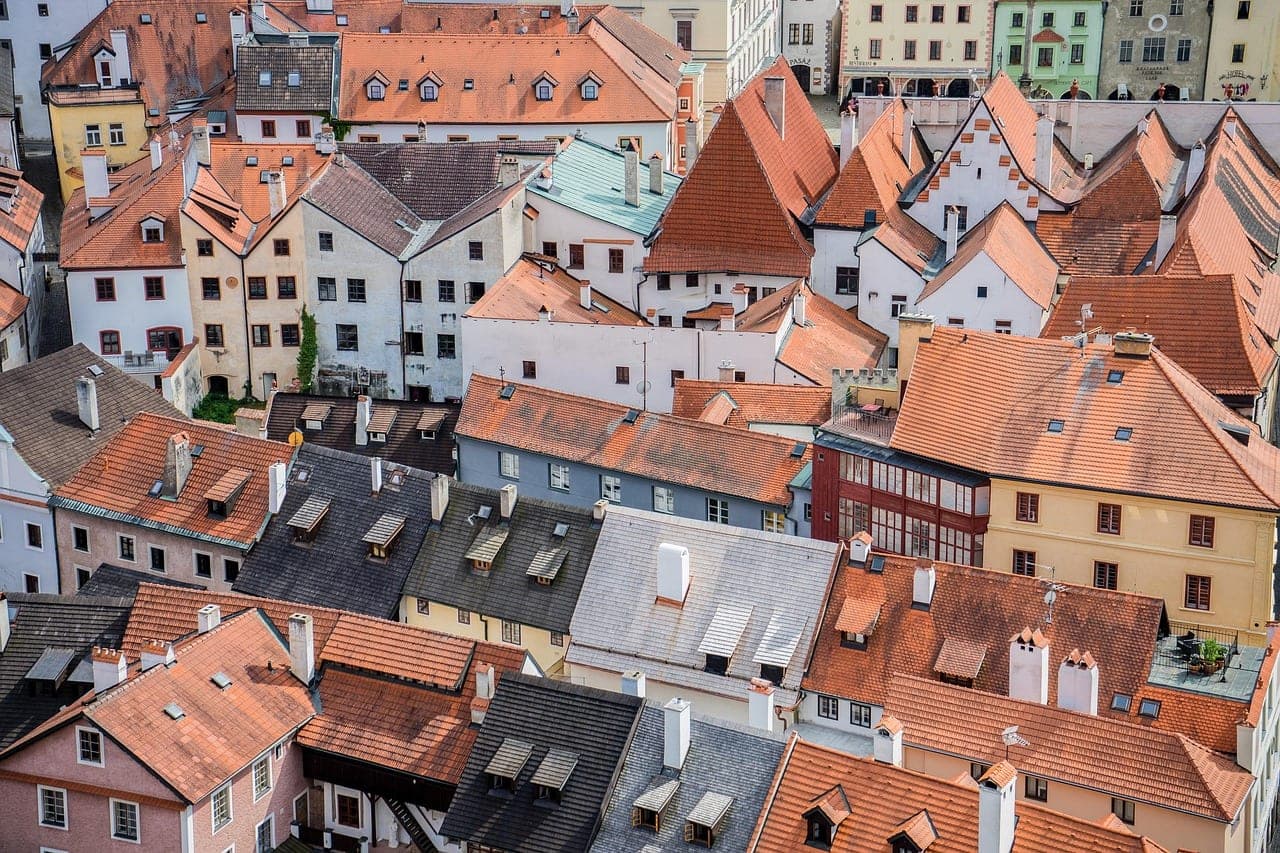
PRAGUE TODAY. A pleasant, mild climate is created by the fact that Prague is open to the south, and protected from northern winds by mountains. Most conspicuous to the visitor, though, is the beauty of its buildings, which show three styles: French Gothic, the earlier Romanesque, and the Baroque (introduced during the period of Austrian rule). Unlike other cities in central Europe, Prague escaped destruction during World War II. It emerged practically unscathed, and remains Europe's "Golden City," or, as the French sculptor Auguste Rodin called it, the "Rome of the North."

FEATURES OF THE CITY. Looming over the city is its medieval castle, Hradcany, built when the commercial life of the city was booming, as trade moved up the river. The castle was built to defend this early trading center. The other castle, Vysehrad ("The High Castle"), remains a national symbol, where the nation's great dead are buried (e.g. the composers Smetana and Dvorak, the author Karel Capek, the violinist Jan Kubelik, and many others). Another prominent landmark is the Charles Bridge, named for the great king and emperor Charles IV (14th century) — one of the first stone bridges in Europe. The Town Hall is an ancient monument; it was financed with proceeds from a wine tax levied by King John of Luxembourg. This fact made wine-drinking a patriotic activity, since it helped to support the construction of the city's pride and joy, and the popularity of wine drinking has continued ever since! The Bethlehem Chapel is a monument to the Hussite movement, since it was here that Jan Huss the reformer preached from 1402 until he left for the Council of Constance (at which he was burnt at the stake by the pope). Prague Ghetto is near the Old Town (and the Town Hall), and is one of the oldest Jewish ghettos in Europe, going back to a colony of Jewish traders (9th century). By the 17th century, it had become the focal point of Hebrew culture in Europe. With the abrogation of segregationist laws in 1848, the ghetto's separate identity dissolved, and by the 19th century it was just another district of the city. But many of the old synagogues remain. St. Vitus Cathedral, located in Hradcany Castle, is the burial place of most of Bohemia's kings (thus, the "Westminster Abbey" of Prague), and it's where the Bohemian crown jewels are kept, including some of the world's largest sapphires.

The essay appearing above was prepared by passports, the student travel company. For a selection of overseas tour itineraries visiting the Czech Republic, click here.


All original material copyright © Passports, Inc., 1993-2008. All rights reserved.